Digital Natives, Critical Strangers: The Challenge of Student Critical Literacy in Indonesia's Post-Truth Era
DOI:
https://doi.org/10.51903/k4h62185Keywords:
Digital Literacy, Information Verification , Post-Truth Era, University Students, Critical ThinkingAbstract
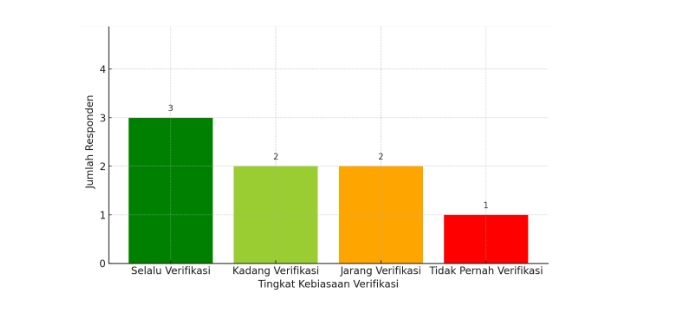
In the post-truth era, where emotional narratives often overshadow facts, digital natives encounter increasing challenges in identifying credible information. This study examines the critical digital literacy of Indonesian university students, focusing on their habits and perceptions in verifying information from online sources. Using a qualitative descriptive method, data were collected from eight students through semi-structured interviews, observational notes, and open-ended questionnaires, and then analyzed thematically. The findings reveal that 75 percent of participants admitted to having believed hoaxes at least once, while only 3 out of 8 consistently verify content before sharing. Platforms such as TikTok and Instagram were the most frequently used sources of information. Trust was often based on virality, familiarity, or emotional appeal rather than the credibility of the source. Some respondents viewed truth as what is widely accepted or repeated within their social circles. Notably, those who had personal experiences with misinformation developed a stronger awareness of the need for fact-checking. This study highlights a paradox between students’ digital skills and their critical literacy. It suggests that epistemic authority is shifting from academic or institutional sources to influencers and peer networks. The research calls for higher education curricula to incorporate critical digital literacy that combines technical ability, ethical reasoning, and emotional awareness. Such integration is vital for preparing students to navigate a complex and often misleading information landscape.
References
Bateman, J., & Jackson, D. (2024). Countering Disinformation Effectively An Evidence-Based Policy Guide. Carnegie Endowment for International Peace. https://carnegieendowment.org/research/2024/01/countering-disinformation-effectively-an-evidence-based-policy-guide
Budianti, N. M., Suwindia, I. G., & Winangun, I. M. A. (2024). Literasi Sains pada Generasi Z : Sebuah Tinjauan Literatur. Education and Social Sciences, 5(2), 137–144. https://doi.org/10.29210/07essr500100
Cahyadi, R. I. (2020, November). Survei KIC: Hampir 60% Orang Indonesia Terpapar Hoax Saat Mengakses Internet. Beritasatu.Com.
Christianti, A. V., Khansa Salsabila, A., Ditya, I., Savara, P., Tanjungpura, U., Barat, K., Profesor, I. J., Nawawi, D. H. H., Laut, B., Tenggara, K. P., & Pontianak, K. (2025). Peran Media Sosial Sebagai Ekosistem Mikro dalam Mendukung Platform E-Learning Berbasis Komunitas: Kajian Literatur Sistematis. Jurnal Ilmiah Sistem Informasi, 4(2), 210–223. https://doi.org/10.51903/twpgeq37
Hikmah, N., Fauzi, A., & Nayyiroh, F. U. (2025). Measuring the forecast accuracy in retail MSMEs: A comparative analysis between AI and traditional methods in the era of digital selling. Journal of Management and Informatics, 4(1), 687–705. https://doi.org/10.51903/jmi.v4i1.166
Hurajová, A. (2025). Enhancing Media Literacy And Critical Thinking Skills at a Slovak University: Exploring Student Perceptions. Juiz de Fora, PPGCOM – UFJF, 19, 102–119. https://periodicos.ufjf.br/index.php/lumina/article/view/47327
Jaleel, A., Aziz, R., Farid, G., & Bashir, M. Z. (2025). The impact of ChatGPT on Academic Integrity in Medical Education: a Developing Nation Perspective. Frontiers in Education, 10, 1–10. https://doi.org/10.3389/feduc.2025.1554444
Joshi, P., & Kumar, D. (2025). Social Media Transforming Higher Education Beyond Likes and Shares. Telangana Journal of Higher Education, 1(1), 43–47. https://tgche.ac.in/storage/2025/06/05-199-Priyanka-Joshi-Social-Media-Transforming-Higher-Education-Beyond-Likes.pdf
Khunsiri, W., Pattanachatchai, N., Nanthawatsiri, P., Thiamsakul, S., & Intaratat, D. (2025). The use of Communication Platforms and Cognitive Heuristics in Political Decision Making of Thailand Novice Voters. Edelweiss Applied Science and Technology, 9(3), 2531–2542. https://doi.org/10.55214/25768484.v9i3.5840
Kristanto. (2020). Integrasi Kecerdasan Buatan dalam Pembelajaran. Jurnal Teknologi Sistem Informasi, 6(March), 114–126. https://doi.org/10.35957/jtsi.v6i1.11329
Lathrop, B. N. (2025). Confronting the Post-Truth Phenomenon in Literacy Education: The Need for a Critical Media Epistemology. Journal of Adolescent and Adult Literacy, March 2024, 665–678. https://doi.org/10.1002/jaal.1407
Lin, Y., & Luo, C. (2025). Old Web in a new Bottle: Thai Digital Natives’ Cyberspace Experience in China. Social Sciences and Humanities Open, 11(May), 101566. https://doi.org/10.1016/j.ssaho.2025.101566
Marolla, G. J., & Riquelme, P. I. (2025). Teacher Education, Diversity, and the Prevention of Hate Speech: Ethical and Political Foundations for Inclusive Citizenship. Societies, 15(5). https://doi.org/10.3390/soc15050139
Masood, M. M., & Haque, M. M. (2021). From Critical Pedagogy to Critical Digital Pedagogy: a Prospective Model for the EFL Classrooms. Saudi Journal of Language Studies, 1(1), 67–80. https://doi.org/10.1108/sjls-03-2021-0005
Media, M. (2025). Minat Baca di Indonesia: Antara Optimisme Data Nasional dan Realitas Peringkat Global. Malelline.Com. https://malline.id/lifestyle/2025/03/2736/minat-baca-indonesia/
Molina, R., Crespo, Y., Árbol, J. R., Arias-Orduña, A. V., Ibáñez-Molina, A. J., & Iglesias-Parro, S. (2025). Exploring the Neurophysiological Basis of Misinformation: A Behavioral and Neural Complexity Analysis. Behavioural Brain Research, 487(July 2024). https://doi.org/10.1016/j.bbr.2025.115592
Nash, B. L. (2024). Emotion, Stimulation, Habit, and Criticality: Learning from Teachers’ Multifaceted Conceptions of Digital Reading. Journal of Research on Technology in Education, 56(1), 7–24. https://doi.org/10.1080/15391523.2023.2264979
Power, J. (2024). Digital Sexual Literacy: the Potential for Online Spaces to Support Sexual Literacy Among Young People. Frontiers in Education, 9(October). https://doi.org/10.3389/feduc.2024.1401252
Rahim, N. bin A. (2025). Media Trust and Verification: Exploring Youth Perspective in the Malaysian Context. https://doi.org/https://doi.org/10.2139/ssrn.5207092.
Redaksi. (2024, November). [Siaran Pers] Temuan Riset Mafindo: Mayoritas Warga Belum Bisa Bedakan Hoaks dan Fakta. Mafindo. https://mafindo.or.id/2024/11/21/siaran-pers-temuan-riset-mafindo-mayoritas-warga-belum-bisa-bedakan-hoaks-dan-fakta/
Risman, O. La. (2021). Penegakan Hukum Pidana Terhadap Penyebaran Berita Bohong (Hoax) Di Media Sosial (Berdasarkan Undang-Undang Nomor : 19 Tahun 2016 Tentang ITE Perubahan Atas Undang-Undang Nomor 11 Tahun 2008 Tentang Informasi dan Transaksi Elektronik). Jurnal Sosial Humaniora Dan Pendidikan (EDUCATION), 2, 1–17. https://journal.stiestekom.ac.id/index.php/Education/article/view/178
Sari, N. T., Rukanda, N., & Elshap, D. S. (2024). Peran Perpustakaan Dalam Meningkatkan Literasi Informasi Masyarakat Di Perpustakaan Desa Padalarang. Jurnal Comm-Edu, 7(2), 258–265. https://doi.org/10.22460/commedu.v7i2.19475
Satria, H., & Sukawati, S. (2023). Pemanfaatan LMS (Learning Manajemen System) Dalam Pembelajaran Mata Kuliah Dasar Umum (MKDU) Di Perguruan Tinggi. Education : Jurnal Sosial Humaniora Dan Pendidikan, 3(3), 105–113. https://doi.org/10.51903/education.v3i3.443
Senft, T. M. (2025). Who Cares How Information Feels? A Call for Digital Influence Literacy. Asian Bioethics Review, 0123456789. https://doi.org/10.1007/s41649-024-00350-0
Thorgeirsson. (2025). What Can Computer Science Educators Learn From the Failures of Top-Down Pedagogy? SIGCSE TS 2025 - Proceedings of the 56th ACM Technical Symposium on Computer Science Education, 1, 1127–1133. https://doi.org/10.1145/3641554.3701873
Tomassi, A., & Falegnami, A. (2025). Disinformation in the Digital Age : Climate Change , Media Dynamics , and Strategies for Resilience. Publications, 13, 2–32. https://doi.org/10.3390/publications13020024
Wang, S. (2025). The Dilemma of Hindering the Development of Chinese National Community Consciousness in the Post-Truth Era and Proposed Countermeasures. Pedagogy and Psychology of Sport, 1–14. https://doi.org/10.12775/PPS.2025.22.60171
Zuhriyah, N. F. (2025). Digital Ethics and Media Literacy : Assessing the Role of Education in Preventing Social Polarization in the Post-Truth Era. Injurity: Journal of Interdiciplinary Studies, 4(2), 96–101. https://doi.org/10.58631/injurity.v4i2.1419
Downloads
Published
Issue
Section
License
Copyright (c) 2025 Nining Fitriani, Ahmad Ashifuddin Aqham, Kholid Wahid, Abdul Muin

This work is licensed under a Creative Commons Attribution-ShareAlike 4.0 International License.
All articles published in this journal are open access and licensed under the terms of the Creative Commons Attribution-ShareAlike 4.0 International License (CC BY-SA 4.0).
Under this license:
-
Authors retain copyright of their work.
-
Others are free to:
-
Share — copy and redistribute the material in any medium or format;
-
Adapt — remix, transform, and build upon the material for any purpose, even commercially;
-
-
As long as they:
-
Give appropriate credit to the original author(s) and the source;
-
Provide a link to the license;
-
Indicate if changes were made;
-
Distribute their contributions under the same license as the original.
-
This ensures that derivative works will also remain free and open under the same terms.